Friday, January 20, 2012

Talking about Portraits: Interactive Portrait Activities

This week the 4th graders are learning about portraiture through the study of Moche portrait vessels and 3rd grade students will be discussing the famous sculptor Bernini next week, so I thought it would be the perfect time to talk about some of the interactive sites I have found the last couple years that explore portraiture and are useful sites and activities for elementary students:

Great site for creating your very own virtual Picasso abstract portrait

FACES AND PLACES is a two-part interactive activity inspired by the National Gallery’s extensive collection of American naive artists, a gift to the nation from Edgar William and Bernice Chrysler Garbisch. Elements from more than 100 paintings have been included in these presentations. Using these two programs, young artists can create portraits, landscapes, or genre scenes of daily life.

From what I can gather, this is a caricature interactive that uses portions of Sheffield Museum (UK) portraits to create your own.  Easy to navigate and fun to play with!

Walker Museum in Liverpool walks kids through an interactive about several elements from portraits in their collection.

These are some of the one's that I have found work well with kids in the lab to give them a start in learning a little bit more about the elements of portraiture.  Have any ones you know of?  Hit me with the link in the comments.

Wednesday, January 18, 2012

Facebook and Fakebook

In our social media-enhanced lives, it is easy for us to forget how not too long ago keeping in touch was a major hurdle in rural school systems.  Passing information through the grapevine now takes on a new meaning as tweets and wall updates have replaced the newsletter and even e-mails to an extent.

As my building begins to dive deeper into the "high touch" aspects of using Facebook to more effectively communicate with parents and community members, I can't help but think of how we would achieve better communication in our school without social media?  It seems so long ago that we were facing these challenges without social media, only it was just a few years back when most of us were navigating the social realm and trying to engineer ways for both sharing and managing our lives for all to see.

Sitting in the parent meetings about what their take is on the use of Facebook makes me reminisce back to when I was trying to find a Facebook voice and wondering how this was going to fit into my life.  Thankfully for our students, our teachers have been a part of this evolution and are now ready to impart knowledge of how to successfully manage such networks without both inflicting or receiving harm from our circles of followers out there in cyberspace.

But how do we teach these 21st century skills to our students?  One way, is to leverage the technology being produced around us to inject classroom curriculum goals into technology projects and use modern influences to drive real learning and smash together media literacy with grade level standards.
Enter Fakebook...
Fakebook by Classtools has given teachers the ability to create fictitious Facebook pages that can be used to increase understanding of classroom concepts while teaching younger students about what is OK to place online for all to see.  Imagine a teacher in class using Fakebook to create profiles for story characters or in my art/tech classroom creating profiles for artists or even for famous technology pioneers.  All of this while also discussing with students proper e-etiquette when negotiating social networking sites.  Fakebook requires no registration, but has limited features, but with an email address you can use My Fake Wall to add more content and even give fake wall updates.

Tuesday, January 17, 2012

Doodlers Unite!

After trying most of the note-taking and organization apps out there, I have come a conclusion:  Sometimes you cannot beat good old-fashioned pencil and paper.  For the last 3 years, I have been able to use my 5.5X8.5" Molskine notebook with grid lines to pretty much accomplish organizing my thoughts.  Each year I have filled one and then I place it on a bookshelf at home.  My hopes are that one day my daughter will have stacks of note/sketchbooks to look at to remember her father.  DaVinci I am not, but it's something that I have started to do and I am not looking back.
The visual learner in me loves to use paper notes because I am not constricted to margins, size, or any electronic organizing principle.  I can write wherever I want.  Mostly, The paper notes also make it easier for me to draw pictures, which is the most important aspect to my note-taking and thought organization.  So to say it plainly:  I am a doodler.  This looks unprofessional and immature in meetings, but I have found some proof that my note-taking strategies are actually quite helpful to linear thinkers!

Wednesday, January 11, 2012

Starry Cities

The 4th grade students used Google Art Project to look at how VanGogh used lines and patterns to create a rhythmic sky in his Starry Night.  With the help of some watercolors and a white oil pastel, the students used patterned lines and brushstrokes to create their very own starry sky.  While those were drying, we used PowerPoint and it's shape tools to create our own small city nestled under a vibrant sky.  The students researched some of the worlds tallest and coolest skyscrapers before creating a future city slide then printed it onto overhead film so it could be placed on their watercolor sky.

Monday, January 9, 2012

2nd Grade Snowman Portraits

For our project before Holiday break, the second grade students learned a little lesson about warm and cool light and shadows with the help of some impressionist artists and a snowman.

The Snowman is one of my favorite Holiday movies.  This short film, based on the book by Raymond Briggs is a classic and a great way to encourage little second graders to think outside the box and create snow-people themselves.

To get the students to start thinking about breathing life into a snow-person, we first need to make our snow-people look life-like!  A lesson from a master of light and shadow helped us:  Claude Monet.

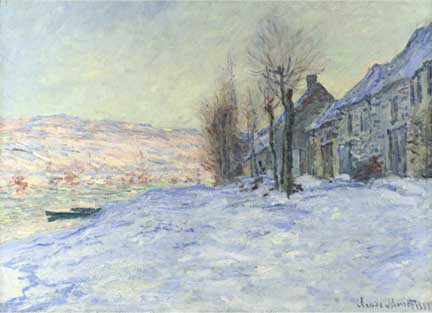
Monet's depiction of Lavacourt Under Snow is a great introduction to how light and shadow plays on snow.  Cool, dark colors can be found in the shadows and warm, light colors bathe the valley in sunlight.

The students started by drawing a circle and filling it in with a white oil pastel.  They chose one side to blend cool colors into the white and the other side was blended with warm colors to give it volume.  After that, it was up to the students' imaginations to breathe life into their snow-people!

Thursday, January 5, 2012

A Snowy, Starry Night

If I have never expressed my hatred for glitter, I will do it now.  Glitter is messy, hard to clean up, gets everywhere, and creates a beautiful sparkle when you are an art teacher blowing your nose. That said, sometimes artwork just needs a little bling, so my Christmas present to the 1st graders this year was to break the lock off the glitter cabinet and use it to add sparkle to our Van-Gogh inspired Starry Night pics.

First, we took a good look at Van-Gogh's Starry Night painting.  Google Art Project and their high-res image of the painting make it easy to zoom in and see every little brush stroke made by the artist.  We discussed the cool colors used in the background and how Vincent used tints (adding white to a color).  We then used blue, purple, and some turquoise paint to paint stripes on a vertical piece of paper, adding white stripes between and letting the colors mix to tints on the paper.  The next class, we started to discuss the large cypress tree that sits in the front of Starry Night, and how it looks so dark because it is a silhouette.  Silhouettes are sometimes all we can see at night.  We practiced with black paint making trees before placing one on top of our tinted painting from last week.
  
The next class period was spent trying to maintain a moderate level of composure as I broke out the glitter, modeled the process, then let them go.  You can't argue with the results!